National Policy Dialogue: Devolution of Power and Good Governance in Pakistan
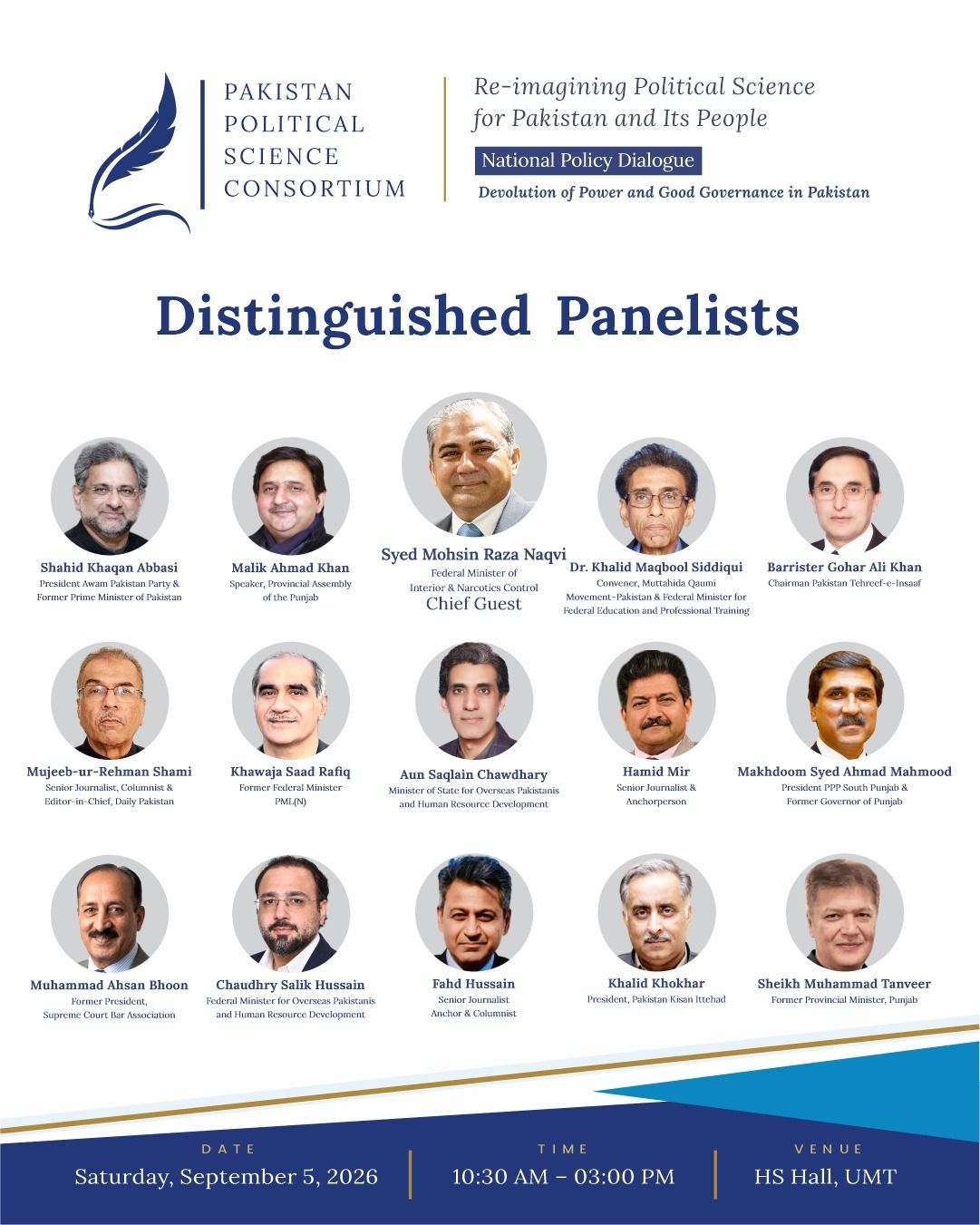
LAHORE, September 5, 2026: The Pakistan Political Science Consortium (PakPSC) convened a National Policy Dialogue on “Devolution of Power and Good Governance in Pakistan” at HS Hall, University of Management and Technology (UMT), bringing together political leaders, former ministers, senior journalists, legal experts and policymakers to debate one of the country’s most consequential governance questions: whether Pakistan needs new provinces, or simply needs its existing institutions to work as the Constitution intends.
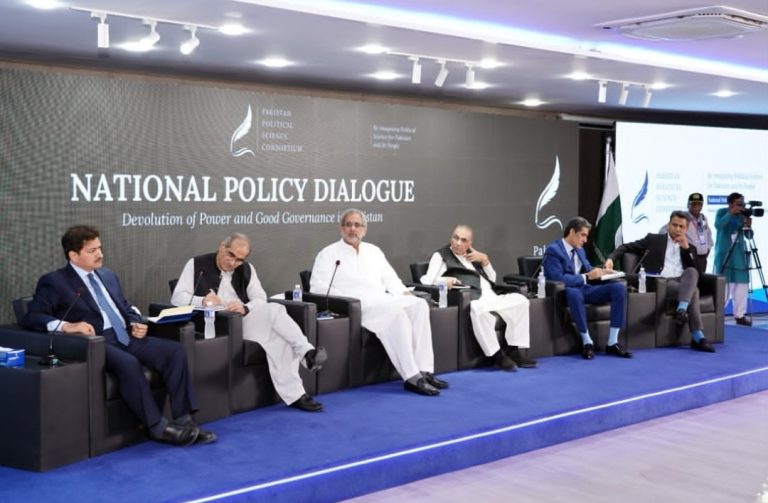
The daylong dialogue, chaired across two panels, moved the conversation beyond the familiar political demand for new provinces into a wider examination of federalism, fiscal devolution, civil service reform and the unfinished business of the 18th Amendment. Federal Minister for Interior Syed Mohsin Raza Naqvi attended as chief guest and delivered the concluding address.
Opening the proceedings, UMT President Ibrahim Hassan Murad set a pointed tone, asking what Pakistan’s thousands of political science graduates and PhD scholars have actually produced for the country’s governance problems. Political science in Pakistan, he argued, needs to be rooted in the country’s own institutional history — from the 1950s through to the present — rather than imported Western frameworks. He urged participants toward evidence-based, non-partisan debate, and framed the day’s central question: which institutional arrangement — empowered local government, greater regional autonomy, or new provinces — best serves ordinary citizens.
Panel I: Rethinking Federalism: Provinces, Politics & the Constitution
The first panel, moderated across contributions from Khawaja Saad Rafique, Mujeeb-ur-Rehman Shami, Shahid Khaqan Abbasi, Aun Saqlain Chaudhary, Fahad Hussain and Hamid Mir, opened with senior journalist Mujeeb-ur-Rehman Shami tracing Pakistan’s constitutional history from the abrogated 1954 draft through the 1956, 1962 and 1973 constitutions, arguing that the country’s colonial-era administrative structure has persisted largely unchanged beneath decades of amendment. “Tabdeeli na-guzeer hai — kam se kam nuqsan, zyada se zyada faida ke liye,” he said: change is inevitable, and the goal must be to minimise losses while maximising benefit.
Former federal minister Khawaja Saad Rafique said Pakistan is still governed by what he called the “Black Englishman” — a domestic elite that inherited colonial habits of rule. While he personally favours smaller administrative units, he argued the deeper obstacle is intent, not structure: “Niyat ki kharabi hai.” He pointed to double standards in how provincial grievances are treated, and called for a more active civil society to drive constitutional reform.
Senior journalist Fahad Hussain reframed the debate entirely, arguing that the real question is not “how many provinces should Pakistan have?” but “what administrative structure can actually improve the quality of life of Pakistani citizens?” He pointed to Pakistan’s weak performance on education, healthcare, poverty and food security as the true measure of governance failure.
Former prime minister Shahid Khaqan Abbasi cautioned that new provinces address only a small part of a much larger structural problem. The core issue, he said, is institutional non-performance — political leaders are reluctant to devolve real authority (“iktidar”), preferring to devolve funds instead. Any restructuring, he insisted, must follow constitutional and legal process rather than political expedience.
Senior anchorperson Hamid Mir pressed the constitutional angle further, invoking Articles 1 and 239(4) as the provisions governing how new provinces can be created, and noting that parties which once passed resolutions supporting new provinces — including a division of Punjab and a separate Hazara province — have since reversed course. He argued that if new provinces are created at all, four to five should be established through a fair, consistent constitutional process.
Minister of State Aun Saqlain Chaudhary closed the panel on an economic note, arguing that smaller, competitively empowered units — as Pakistan saw under the elected District Nazim system of 2002 — tend to generate more local leadership, revenue and services.
In closing remarks, panellists converged on a shared, if unresolved, conclusion: power should ultimately rest at the local level, but no one on the panel had a definitive roadmap for how to get there.
Panel II: Strengthening Governance — Empowerment through Administrative & Fiscal Devolution
The second panel turned from constitutional theory to the mechanics of administrative and fiscal devolution, with contributions from Sheikh Muhammad Tanveer, Dr Khalid Maqbool Siddiqui, Punjab Assembly Speaker Malik Muhammad Ahmad Khan, Chaudhary Salik Hussain, Makhdoom Syed Ahmad Mahmood, Muhammad Ahsan Bhoon, Khalid Khokhar and Hamid Mir.
Speaker Malik Muhammad Ahmad Khan opened by calling for civil service reform that places authority more clearly with elected representatives, and for clarity on the overlapping responsibilities of federal, provincial and local governments.
Makhdoom Syed Ahmad Mahmood, President of PPP Southern Punjab and a former Governor of Punjab, offered what became one of the day’s more quoted formulations: “Good governance is actually good politics.” He identified visionary leadership, and the absence of nepotism and corruption, as the three preconditions for reform, and argued that fiscal devolution cannot stop at the provincial level — the Provincial Finance Commission must move resources down to districts and communities, just as the NFC moves them from the federation to the provinces.
Federal Minister Chaudhary Salik Hussain suggested one practical route forward: converting existing administrative divisions into provinces, reducing the concentration of authority in large provincial capitals without requiring a wholesale constitutional overhaul.
Speaking for the agricultural sector, Pakistan Kissan Ittehad President Khalid Khokhar said farmers receive a fraction of their promised budgetary allocation — about 12.77 percent against a promised 65 percent — and pointed to the politicisation of wheat pricing and subsidised “sasti roti” schemes as evidence of governance failing at the grassroots.
Returning to the podium, Hamid Mir argued that up to four additional provinces could in principle be carved from the four existing ones, bringing the total to eight, and asked why Pakistan could not produce mayoral leadership of the kind seen internationally if local government were genuinely empowered.
Dr Khalid Maqbool Siddiqui, MQM-P convener, described Pakistan’s system as a “feudal democracy” (“jagirdarana jamhooriyat”) and argued that the country’s core deficit is one of intention and trust as much as finance — a “trust deficit” alongside a fiscal one.
Former Supreme Court Bar Association president Muhammad Ahsan Bhoon grounded the debate in Article 1 and Article 239(4) of the Constitution, insisting that any change to provincial boundaries must proceed through cross-party dialogue, not unilateral action.
Chief Guest Address: Syed Mohsin Raza Naqvi
Closing the dialogue, Federal Minister for Interior Syed Mohsin Raza Naqvi said that if the existing system is not functioning, all stakeholders should come together to fix it — and that both new administrative units and new provinces remain possible outcomes, provided change happens constitutionally, democratically and by consensus rather than by unilateral decision. Invoking the Quaid-e-Azam’s 1948 warning that “provincialism is the greatest of all curses,” he argued the debate should not be framed along ethnic or biradari lines but around a straightforward set of questions for Parliament to settle: how many provinces or units, what their boundaries should be, and where their funding would come from.
He summarised his position in four principles: government should be closer to the public; government should be answerable; there must be unified political will; and any change must occur within the Constitution.
The Takeaway
The dialogue’s central conclusion was that territorial restructuring is a means, not an end. Pakistan could redraw its provincial map and still retain the same centralised political culture, weak local government and fiscal dysfunction that hamper governance today. The consistent thread across both panels was that reform must be judged by outcomes — in education, healthcare, employment and justice — and pursued through constitutional process and political consensus, not partisan advantage.