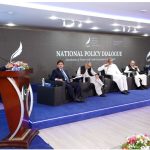
The first panel, moderated across contributions from Khawaja Saad Rafique, Mujeeb-ur-Rehman Shami, Shahid Khaqan Abbasi, Aun Saqlain Chaudhary, Fahad Hussain and Hamid Mir, opened with senior journalist Mujeeb-ur-Rehman Shami tracing Pakistan’s constitutional history from the abrogated 1954 draft through the 1956, 1962 and 1973 constitutions, arguing that the country’s colonial-era administrative structure has persisted largely unchanged beneath decades of amendment. “Tabdeeli na-guzeer hai — kam se kam nuqsan, zyada se zyada faida ke liye,” he said: change is inevitable, and the goal must be to minimise losses while maximising benefit.
Former federal minister Khawaja Saad Rafique said Pakistan is still governed by what he called the “Black Englishman” — a domestic elite that inherited colonial habits of rule. While he personally favours smaller administrative units, he argued the deeper obstacle is intent, not structure: “Niyat ki kharabi hai.” He pointed to double standards in how provincial grievances are treated, and called for a more active civil society to drive constitutional reform.
Senior journalist Fahad Hussain reframed the debate entirely, arguing that the real question is not “how many provinces should Pakistan have?” but “what administrative structure can actually improve the quality of life of Pakistani citizens?” He pointed to Pakistan’s weak performance on education, healthcare, poverty and food security as the true measure of governance failure.
Former prime minister Shahid Khaqan Abbasi cautioned that new provinces address only a small part of a much larger structural problem. The core issue, he said, is institutional non-performance — political leaders are reluctant to devolve real authority (“iktidar”), preferring to devolve funds instead. Any restructuring, he insisted, must follow constitutional and legal process rather than political expedience.
Senior anchorperson Hamid Mir pressed the constitutional angle further, invoking Articles 1 and 239(4) as the provisions governing how new provinces can be created, and noting that parties which once passed resolutions supporting new provinces — including a division of Punjab and a separate Hazara province — have since reversed course. He argued that if new provinces are created at all, four to five should be established through a fair, consistent constitutional process.
Minister of State Aun Saqlain Chaudhary closed the panel on an economic note, arguing that smaller, competitively empowered units — as Pakistan saw under the elected District Nazim system of 2002 — tend to generate more local leadership, revenue and services.
In closing remarks, panellists converged on a shared, if unresolved, conclusion: power should ultimately rest at the local level, but no one on the panel had a definitive roadmap for how to get there.